Tampilkan postingan dengan label PORSCHE. Tampilkan semua postingan

Minggu, 25 April 2010

Porsche Cayenne – the new 2010 4x4 steps out


It's not long now until Porsche replaces the Cayenne SUV, its most controversial model line ever. Probably. The new Cayenne Mk2 will arrive in spring 2010 with a raft of changes to keep buyers and politicians alike happier with the idea of a hulking great sporting SUV.

Our new spy photos reveal how the new 2010 Cayenne will adopt a slightly softer form language. The back lights appear to be less upright, with a more horizontal shape, split between rear panel and tailgate; the rear of the car appears more pinched for improved aerodynamics; and the front grille is now a less fussy design.

As is the wont of designers at the turn of the decade, the Cayenne's face is dripping with LEDs – a 911 Turbo style day-running light bar bisects the outer air intakes. Prepare to be blinded.

It looks a bit like an Infiniti crossover!

Well, the front three-quarters photos certainly suggest the Cayenne has a curvier style. We can indeed see a little bit of Infiniti FX in the more rounded character lines and swoopier glasshouse. Net effect? It makes the new 2010 Cayenne look less aggressive, more crossover inspired, less brutal, which can only be a good thing.

This is exactly what Porsche is aiming for with its second-gen 4x4. The technical changes underline this: engines will be tweaked for marginal power increases but more significant CO2 and mpg gains. Not least the new hybrid.

A hybrid Porsche? It must be their first electric production car

Indeed it is (although don't forget Ferdinand Porsche's extraordinary Lohner-Porsche full EV of 1899). CAR has already driven the prototype Cayenne Hybrid several times, and the latest iteration uses the Audi 3.0-litre V6 petrol mated to sophisticated hybrid hardware twinned with the gear being readied for the new VW Touareg due at the 2010 Detroit auto show.

The new petrol-electric Cayenne will certainly be a political statement for Porsche, and signals a rush of new part-electrified models. Next up is the Panamera Hybrid.

Senin, 01 Maret 2010

2007 Porsche 911 Turbo

Porsche 911 Turbo Porsche has successfully designed yet another impressive sports car that is not only beautiful to look at, but also easy to drive and incredibly fast. The 2007 Porsche 911 Turbo is the sixth generation of the 911 model, and it is both functional and stylish. The electronically controlled all-wheel-drive system and styling have received complete overhauls, resulting in a superior vehicle that is perfect for the road or the racetrack.

Variable Turbine Geometry


One of the highlights of the 2007 Porsche 911 Turbo is the variable turbine geometry (VTG) for the exhaust gas turbocharger on the vehicle’s power unit. Innovative aerospace-grade materials allow the turbocharged gasoline engine to operate efficiently and safely, even in very high temperatures. VTG increases the 3.6-litre engine’s output from 420 to 480 horsepower by utilizing an advanced control algorithm and by better controlling the exhaust gas flow. Regardless of the engine speed, VTG directs the air in the appropriate direction and angle in relation to the adjustable turbine blades. The revolutionary design also increases the maximum torque from 415 to 460 lb/ft.

Design

Numerous changes have been made to the styling of this impressive sports car. Changes to the 2007 Porsche 911 Turbo’s front end include fog lights that are deep set and widely spaced, LED indicators that appear in the air inlets and cooling air inlets that are drawn very tightly.

The changes to the rear of the 911 Turbo include a tail that is 0.9 inches wider than the one found on the previous model. The wing spoiler slopes downward and has been restructured to fit the wider profile. It is designed to rise automatically as soon as the driver exceeds 120 km/h. Behind the doors, you will find redesigned large lateral air inlets. They do a better job of cooling air to the intercoolers thanks also to the new air ducts introduced in this particular model.

Speed

Porsches are known for their speedy performance, and the Porsche 911 Turbo is no exception. This sports vehicle can reach impressive speeds of 0 to 100 mph in a mere 7.8 seconds. Reaching 0 to 30 mph takes only 1.1 seconds which is an amazing feat. The standard 911 Turbo is incredibly fast and includes a six-speed manual transmission. However, you need to purchase the Tiptronic S five-speed automatic transmission option if you want to obtain maximum performance and soar past the 191-mph mark.

Sports Chrono Package

If you a true speed demon and are searching for an extra adrenaline rush, you may want to consider purchasing the extra sports chrono package. This option will allow drivers to gain a brief boost of power and speed once they engage the Sport button. The turbocharger boost pressure is increased when the vehicle is operating under full throttle and mid-range engine speeds. Specifically, the torque is increased by 45 lb/ft (60 Nm) to an impressive 505 lb/ft (680 Nm). Just imagine the fun you can have if you decide to overtake another vehicle and show others how this remarkable supercar can perform!


Porsche 911 Turbo profile view Porsche 911 Turbo at car show Porsche 911 Turbo rear-left view Porsche 911 Turbo focus on wheels
Porsche 911 Turbo at car show II Porsche 911 Turbo rear headlight Porsche 911 Turbo rear headlights in detail Porsche 911 Turbo in blue light
Porsche 911 Turbo left side Porsche 911 Turbo left view, car show Porsche 911 Turbo car show photo Porsche 911 Turbo bevelled view from right-front
Porsche 911 Turbo front detail Porsche 911 Turbo front with flash


Images were reprinted with permissions from original author Chris Ostberg (AudiWorld.com)! Content was written by Tracy McCaskill for sport-cars.org only and you MAY NOT copy, distribute or use this page's content for any commercial or non-commerical purpose without written permission of this site owner and photos authors!

Porsche GT3

Porsche’s new 2007 911 GT3 made its public debut at the Geneva Motor Show on February 28, 2006. The latest race-bred 911 sports coupe features a 415-horsepower naturally aspirated engine with an 8,400 rpm redline, an active suspension setup tuned for the track, and a mechanical limited-slip differential.

Serving as the homologation basis for Porsche’s 911 GT3 RSR racecar, the 911 GT3 provides enthusiasts with an uncompromising road car that can easily transition to weekend track-day outings. The 415-horsepower, 3.6-liter flat-Six engine produces a specific output of 115.3 horsepower-per-liter, among the highest of any naturally aspirated production car. The Boxer engine’s power peak is reached at 7,600 rpm, on the way to an 8,400 rpm redline -- 200 rpm beyond the previous GT3 model.

In addition to its high-revving characteristics, the Porsche GT3 engine’s performance has been fortified by careful attention to airflow rates. Changes to the variable intake system include a throttle valve enlarged from 76 to 82 millimeters, optimized cylinder heads, and a low-backpressure exhaust system.

To take advantage of the extended-rev characteristics of the engine, the 2007 911 GT3 features a revised six-speed manual transmission, with lower gear ratios for 2nd through 6th, as well as shortened shift-lever throws. A new change-up display, which illuminates the tachometer shortly before the relevant engine speed is reached, provides GT3 pilots with an additional signal to optimize shift timing.

The combination of a more powerful, higher-revving engine and shortened gear ratios produces impressive acceleration figures, allowing the 2007 911 GT3 to reach 60 mph from a standstill in 4.1 seconds, and 100 mph from a standing start in 8.7 seconds. The top test-track speed of the new 911 GT3 is 193 mph.

For the first time, the 911 GT3 boasts an active suspension. The standard Porsche Active Suspension Management (PASM) system offers two chassis in one: the basic configuration is similar to that of the previous model and is suitable for driving on alternating road surfaces. In Sport mode, the system provides even firmer damping, enabling more focused dynamics for the racetrack.

For the best possible transmission of engine power to the road, the GT3 is equipped with a comprehensive traction package, including new electronic Traction Control adapted from the Carrera GT, standard-equipment 19-inch sports tires, and a mechanical limited-slip differential. The new Traction Control setup features traction-slip and drag-torque control functions, allows the safe application of power under any driving conditions, and can be completely disabled if desired.

The 2007 Porsche 911 GT3 will be available in North America beginning in August 2006.

Porsche Panamera PS9

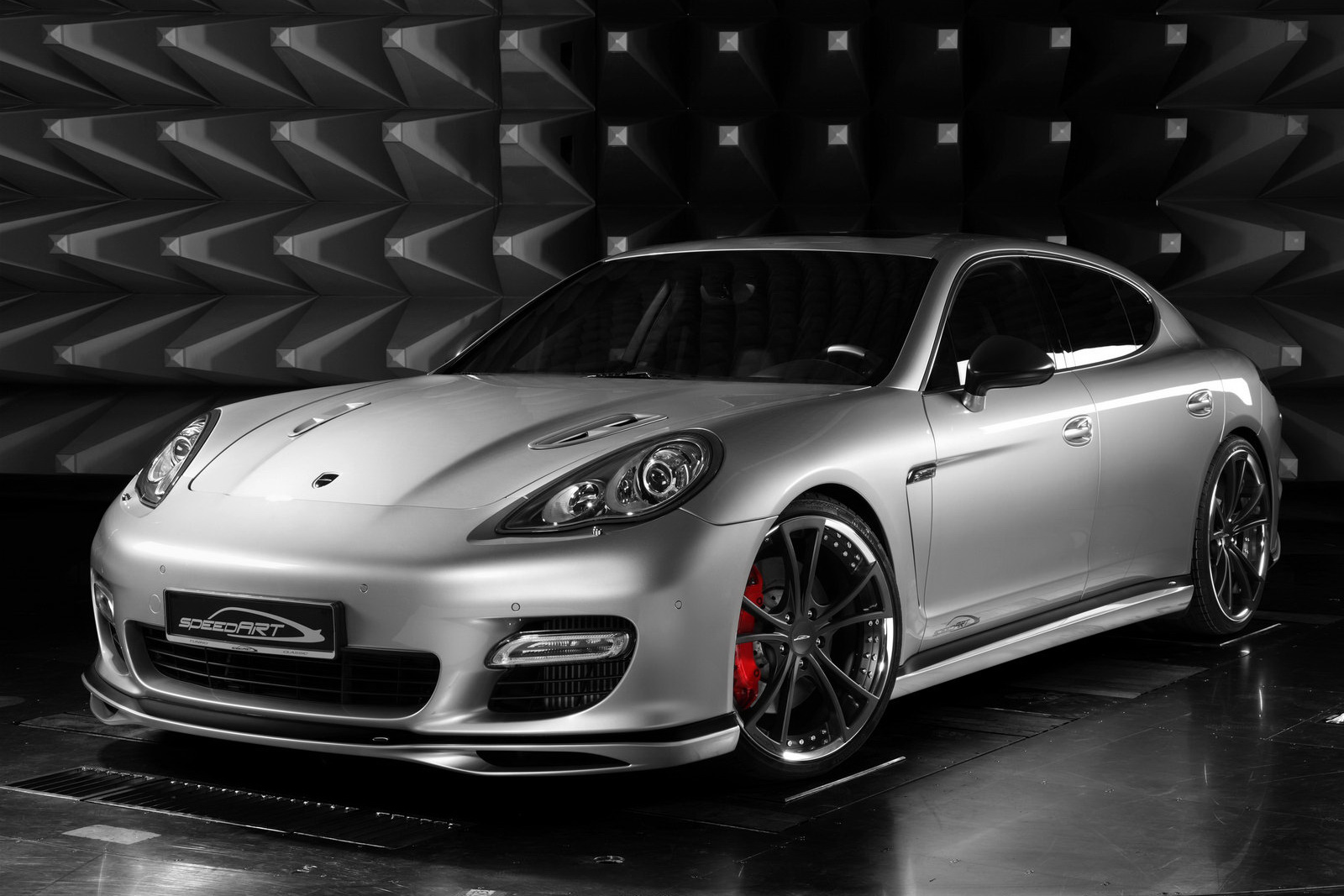
New Porsche Panamera PS9 Unveiled At Essen Motor Show

https://blogger.googleusercontent.com/img/b/R29vZ2xl/AVvXsEjvVTXkUB0uBS-S1LzeATklMo6cp7sK3CEX1FAPhGfvjMI0Knyz8yub10miep6oaQu9tbLAtJVHXkZNVLZ0fhMTz1Fyj1emY3B-3YLNgn2m2RLwgya__QSy9-WEDr5x90bkZ5gblp8WFcA/s1600/Porsche-Panamera-SpeedART-12.JPG https://blogger.googleusercontent.com/img/b/R29vZ2xl/AVvXsEhkOlZjvB2TH9EV04h7Xqxn5o0vbUhue4iPf8-T60s8qgDFxJFLOOus7LCgbSqvy9whnJfQF2qZDjtDb4ZINa09ef3vyaWpVlMh9H0iNcWKMBiiiZdhX2oT18YUmvZ5rXuKBkdFUIc4-ck/s1600/Porsche-Panamera-SpeedART-3.JPG

The famous sports car brand, Porsche showed up with its new Panamera PS9 at the Essen Motor Show. The German tuning house releases some of its images of that motor show where the Porsche can be seen embedded with its sports package that bundles aerodynamic add-ons with some performance upgrades and four different power kits for the turbo model.

As usual, the PS9 aerokit includes a front spoiler with an integrated brake cooling system with rigid side skirts, engine hood air vents, air outlets coming through the rear bumper, a fixed rear spoiler and a rear diffuser that houses a twin tail pipes. That's not it. Its a complete package deal. You also get a set of 22 inch alloy wheels along with high performance tires of 265/35 and 305/25 ZR22


Coming to the new Porsche's interior, the steering's covered with leather, pedals of two sizes which are 340 and 365 mm are F1-shift type. You have a choice of selecting the pedals in wood, aluminium or carbon fiber. Door panels and seats are stitched with color threads, exclusive floor mats and carbon fiber decorative trim available in various shades.

The new Porsche Panamera PS9 has an upgraded turbo chargers,sports air filter, sports exhaust system and an effecient ECU. All these upgrades really pimps out the car and results in increased horsepower of 600 to 650 and produces an immense torque of 890 Nm. The new Panamera has an ability of boosting from 0 to 100 km/h in just 305 secs. The manufacturers have not only concentrated on the speed and acceleration. In order to bring a fast moving to a halt, sure require some extra ordinary brakes system. So an upgraded brakes system has been installed with modular 380 mm and 6 piston brake callipers.

Jumat, 26 Februari 2010

PORSCHE CAYMAN REVIEW

Porsche Cayman Review

Porsche Cayman
http://a332.g.akamai.net/f/332/936/12h/www.edmunds.com/pictures/VEHICLE/2007/Porsche/2007.porsche.cayman.20106753-396x249.jpg
2007 Porsche Cayman Coupe

Ever since Porsche introduced the midengine Boxster as a return to the "affordable" Porsche, enthusiasts have been clamoring for a hardtop version. The argument was that a version with a proper roof would be more rigid, less expensive, lighter and a better performer at the track than a convertible. Pleas were finally answered with the 2006 debut of the Porsche Cayman. Based on the second-generation Boxster, the Cayman coupe (whose name is said to reference an alligator indigenous to Central and South America) shares much of its mechanical midengine underpinnings with its drop-top sibling. However, it does wear unique and very attractive sheet metal.

The Porsche Cayman combines its drop-dead gorgeous looks with brakes that beg to be pushed hot into a corner, a chassis that gladly guides the driver around the apex and a choice of two engines that will enthusiastically sing as they slingshot you down the straightaway. Some of our editors who have driven the Cayman extensively report that its well-balanced chassis could actually handle considerably more power, and it's suspected that Porsche limited the Cayman's capabilities as not to overlap with its seminal 911.

If there's a complaint, it's that the Cayman is priced considerably more than its competitors, especially when a host of desirable options are selected. But when it comes to providing a combination of all-around performance, sublime driver interaction, day-to-day comfort and desirable prestige, we can't think of a better car in this segment than the Cayman.

Current Porsche Cayman

The midengine Porsche Cayman is offered in two models, the base Cayman and the Cayman S. The base Cayman is powered by a 2.7-liter six-cylinder boxer engine that produces 245 horsepower and 201 pound-feet of torque, backed by a five-speed manual transmission. Step up to the Cayman S and the engine expands to 3.4 liters and power grows to 295 hp and 250 lb-ft of torque. In addition, the number of cogs in the transmission increases to six. Optional on both models of the Cayman is a five-speed Tiptronic automatic transmission with a manual-shift mode.

When it comes to the suspension, the Porsche Cayman takes advantage of its stiffer-than-a-convertible structure by offering a level of handling and nimbleness that is a step above the capabilities of the Boxster. Safety aids include antilock brakes, traction control and stability control, all tuned to intervene only when absolutely necessary so as not to detract from the sporting nature of the Cayman. Optional is Porsche Active Suspension Management (PASM) which, via a variety of sensors, electronically and automatically adjusts the suspension to optimize either comfort or handling, depending on the setting and the driver's level of aggression. Larger wheels and tires round out the suspension options and help to improve braking. Braking performance is further enhanced on the Cayman S by optional carbon-ceramic brakes.

The interior accommodations take their cue from the Boxster and offer the typical Porsche combination of sport and luxury, with leather and metallic accents decorating the cabin. The leather-appointed seats possess the ability to both hold the driver in place during spirited maneuvers and to coddle driver and passenger during more serene outings. High-end audio and navigation are available on both Cayman models, though the base stereo offerings are disappointing for a car in this price range. Cargo room is generous for such a small and sporting vehicle, as the midengine layout allows for both fore and aft cargo areas that together equal the trunk space of a midsize family sedan.

Past Porsche Cayman Models

The Porsche Cayman made its debut in the 2006 model year. For the first year, only the Cayman S model was available. The base Cayman model launched for 2007.

PORSCHE BOXSTER REVIEW

Porsche Boxster Review

Porsche Boxster
http://a332.g.akamai.net/f/332/936/12h/www.edmunds.com/pictures/VEHICLE/2007/Porsche/2007.porsche.boxster.20099245-396x249.jpg
2007 Porsche Boxster Convertible

When it debuted in the late '90s, the Porsche Boxster ushered in an era of the more affordable Porsche convertible. Featuring a finely balanced midengine layout, sublime handling and steering, and the performance of a proven, sophisticated flat-6 engine, the Boxster quickly became part of the Porsche legend and one of the best-selling cars in the luxury roadster class.

There are several big-name competitors with equivalent cachet, but one drive in a Boxster is often all it takes to end a sports car shopping trip. Several evolutionary updates and detail changes through the years have kept the Boxster generally competitive in the face of faster and newer rivals. The latest version is the most powerful ever, with almost 300 horsepower available.

Inside, the quality of materials used has improved over the years and late-model Boxsters certainly project the aura of a premium sports car. With two ample cargo holds front and rear, the Boxster is a mostly practical daily driver, too. Though its competitive breeding can manifest an edgy nature that's sometimes a bit much around town or during lengthy commutes, our editors believe the Porsche Boxster is the quintessential top-down, high-speed weekend getaway device for two.

After a decade in production, the classically styled Porsche Boxster also remains a serious, purpose-built midengine sports car designed to travel hard and fast -- sometimes demanding a driver's undivided attention but rewarding the skilled pilot with razor-sharp feedback and unmatched thrills and satisfaction behind the wheel. If that's what you're after and you can swing a sometimes pricey bottom line, you couldn't convince us of a more compelling choice, new or used.

Current Porsche Boxster

Now in its second generation, the Boxster continues to be available in the base version or as the more powerful Boxster S. The base model has a horizontally opposed, 2.7-liter six-cylinder engine. Mounted amidships, it's rated at 245 hp and 201 pound-feet of torque. The Boxster S has a 3.4-liter version that produces 295 hp and 251 lb-ft of torque. A manual or automatic transmission is offered. Standard equipment on both models is respectable but most Boxsters leave the dealership floor with a fair number of additional options, which can elevate the price rather quickly.

In our reviews, the Porsche Boxster's midengine power and classic styling, not to mention its sublime steering and brakes and relative practicality, give it a level of desirability that's hard to deny -- particularly among true sports car enthusiasts. If you keep the options list under control, it can also provide unmatched luxury sports car value.

Past Porsche Boxster Models

The Boxster originally debuted for the 1997 model year. At the time, it was considered to be a key release for the brand. Porsche had been struggling financially through the early and mid '90s and the Boxster's affordability, classic styling and simplicity made it a huge hit with consumers.

The first-generation Porsche Boxster came with a power-operated soft top and a 201-hp, 2.5-liter flat-6 engine. In 2000, the big news was the addition of a second, even more focused S model. The Boxster S featured 250 hp, larger wheels and brakes and a more stiffly tuned suspension. In 2001, the tweaks mostly involved interior refinements in layout and materials quality. But underneath, the sophisticated Porsche Stability Management system was made available for both models. For 2004, Porsche increased the power output of both engines slightly.

The second-generation Boxster arrived for 2005. Porsche applied evolutionary changes to much of the car. The styling was subtly tweaked for a sleeker look and improved the quality and look of the interior. The base 2.7-liter six-cylinder gained a horsepower boost from 228 to 240, and the 3.2-liter six in the S increased from 258 to 280 hp. The current model's outputs went into effect for 2007.

Though reasonable for a luxury-sports roadster, the Porsche Boxster is still among the most expensive cars in its class. Of course, this matters less to a serious sports car shopper, as midengine cars are rare at any price point -- from an enthusiast's perspective, it's all about the Boxster's ability to perform precisely when driven hard. And that it does. But either way -- whether more recent or more than a few years old – a Boxster unladen with lots of expensive optional upgrades makes for a serious used sports car value.